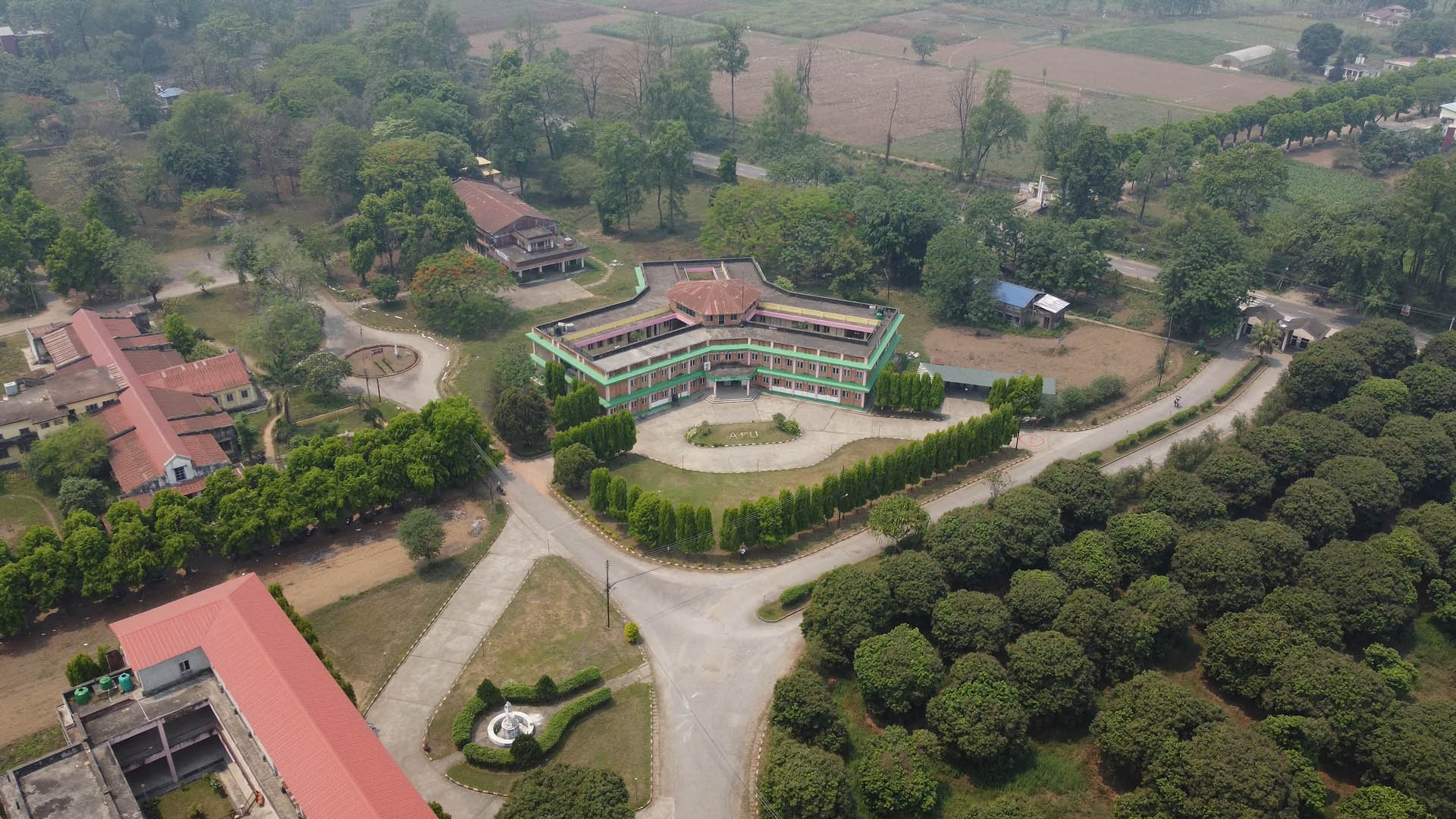
About Faculty of Forestry, Agriculture and Forestry University
The Faculty of Agriculture (FoA) at Agriculture and Forestry University is a premier institution in Nepal dedicated to advancing agricultural education and research.
With expert faculty, modern facilities, and strong national and international collaborations, FoA plays a vital role in producing skilled agricultural professionals and supporting the development of Nepal’s farming sector.
Message from Leadership
I am delighted in welcoming you to the Faculty of Agriculture (FOA) of Agriculture and Forestry University at Rampur, Chitwan, Nepal.
The Faculty was established in 2012 by the University’s first senate meeting with the aim at producing technically competent human resource in agriculture and related areas for the development of agriculture, agro-industries and the socio-economic condition of the Nepalese people.
The faculty is undertaking undergraduate (BSc. Ag.) and graduate programs leading to Master of Science and Doctoral degrees in different areas of agriculture. It now has annual enrollment of 596 undergraduate students within central college located at Rampur, Chitwan and constituent college located in Kaski, Sindhuli, Dhankuta, Mahottari, Banke, Rolpa and Kailali districts on the name of College of Natural Resource Management. The faculty also runs two academic centers: Center for Biotechnology and Centre for Development Studies and Rural Sociology at its central campus in Rampur.
The faculty places a strong emphasis on development of skill and confidence in entrepreneurship in undergraduate students for self-employment. For this, the Learning for Entrepreneurial Experience (LEE) has been integrated in curricula of undergraduate studies which offers enough opportunities to the students in entrepreneurial experiences in the real field. This skill and confidence would motivate our graduate to be an entrepreneur as a job provider. Currently, the LEE is implemented in collaboration with PMAMP of Ministry of Agriculture at Federal Government.
We are dedicated in developing institutional capacity to expand research, training and services to the farming communities, agro-industries, government agencies, and other stakeholders in collaboration with private sector, research institutes, universities, local bodies, state and federal government across the country.
We are committed for academic excellence in teaching and research through developing faculty strength, improving physical infrastructure and facilities and creating better working environment for faculty members, administrative staff and students.
Prof. Arjun Kumar Shrestha, PhD
Dean
Academic Programs
Introduction
- The Faculty of Agriculture (FoA) is one of the three faculties under Agriculture and Forestry University (AFU), located in Rampur, Chitwan, Nepal.
- It is the largest and most significant faculty within AFU, known for its excellence in teaching, research, and outreach activities.
- The main mission of FoA is to produce skilled manpower in agriculture and allied disciplines, contributing to the modernization and commercialization of Nepalese agriculture.
- The faculty also operates an extended undergraduate program through the College of Natural Resources Management in Puranchaur, Kaski.
🎓 Programs Offered
- Bachelor of Science in Agriculture (B.Sc. Ag.) – 4 years
- Started in 2069/70 BS at Rampur and 2072/73 BS at Puranchaur, Kaski.
- Master of Science in Agriculture (M.Sc. Ag.)
Courses offered at Faculty of Forestry, Agriculture and Forestry University
- BSc Agriculture (BScAg)Agriculture and Forestry University
Admission Information
Admission Deadline
- The admission process usually opens once a year after the publication of entrance results by Agriculture and Forestry University.
- Specific dates are announced on the official AFU website and university notice boards.
📄 Admission Requirements
- Applicants must have completed 10+2 Science (Biology Group) or equivalent with at least 50% aggregate marks or C+ Grade in each subject.
- Must pass the entrance examination conducted by AFU.
- Admission is based on merit ranking (entrance exam + academic performance).
Scholarships & Financial Aid
🎖️ Scholarships
- Merit-based scholarships for top-performing students.
- Government and University-funded scholarships for underprivileged and marginalized groups.
- Research grants and assistantships for postgraduate students involved in projects.
- International exchange scholarships through partner universities abroad.
Campus Facilities
Features and Facilities
- Nine specialized departments and two research centers.
- Highly qualified faculty members (52) and dedicated technical staff (67).
- Modern laboratories, research farms, and library resources.
- Science Centers in different agro-ecological zones for field-based research and training.
- Regular workshops, seminars, and international collaborations for knowledge exchange.
- Partnerships with organizations like NARC, USAID, Winrock International, LiBIRD, and others.
Contact Information
Location
Rampur, Bharatpur
Chitwan, Bagmati Province
056-591655, 056-591777
Quick Actions
Related Colleges
Browse all colleges


Admission Opportunities
View all admissionsAdmission Open
B.Arch (Architecture) Admission 2025
Tribhuvan University
Bachelor of Architecture (B.Arch) is a 5-year professional degree program offered by IOE-TU, Kathmandu University, and affiliated colleges. Admission requires clearing the respective entrance exams with an architecture aptitude component.
Bachelor
Deadline: Jul 15, 2025
150 seats
architectureB.Archdesign
Updated: 2026-01-29View Details
Admission Open
B.Pharm (Pharmacy) Admission 2025
Tribhuvan University
Bachelor of Pharmacy (B.Pharm) is a 4-year program preparing students for careers in pharmaceutical sciences. Admission through MECEE-BL for TU/PU affiliated colleges.
Bachelor
Deadline: Jul 1, 2025
600 seats
pharmacyB.Pharmmedical
Updated: 2026-01-29View Details
Admission Open
BCA Admission 2025
Tribhuvan University
Bachelor of Computer Application (BCA) is a 4-year program offered by TU, PU, and Purbanchal University affiliated colleges. Some colleges have entrance exams while others have direct admission.
Bachelor
Deadline: Jul 31, 2025
3,000 seats
ITBCAcomputer
Updated: 2026-01-29View Details